Wednesday, October 10, 2012

d(13): Occupy

   
The most striking works in dOCUMENTA (13) were outside of the main exhibition venues. They occupied specific locales and brought a new layer of meanings to their already rich histories.

Jennifer Allora and Guillermo Calzadilla took over part of the Weinberg Bunker, a Nazi-era brick bomb shelter built into a hillside, for their new film involving a recently unearthed prehistoric flute and a griffon vulture – one of the oldest species on earth. Argentinian artist Adrián Villar Rojas populated the upper terraces of Weinberg with his plaster and concrete sculptures. These curiously shaped objects revealed a parallel universe or a vanished civilization, creating some foreign yet familiar atmosphere.

Weinberg Bunker
Allora & Calzadilla, Raptor’s Rapture
Adrián Villar Rojas, Return the World

Turkish artist Cevdet Erek had his sound installations at Kunsthalle Basel earlier this year. This time at d(13), he occupied a large vacant space and transformed it into a similar installation. In a minimalistic setting, various types of sound systems amplified what he called “sonic time lines.” In this raw vacant space between Galeria Kaufhof and C&A, the piece looked much more powerful and stunning than in a museum setting in Basel.
Cevdet Erek, Room of Rhythms

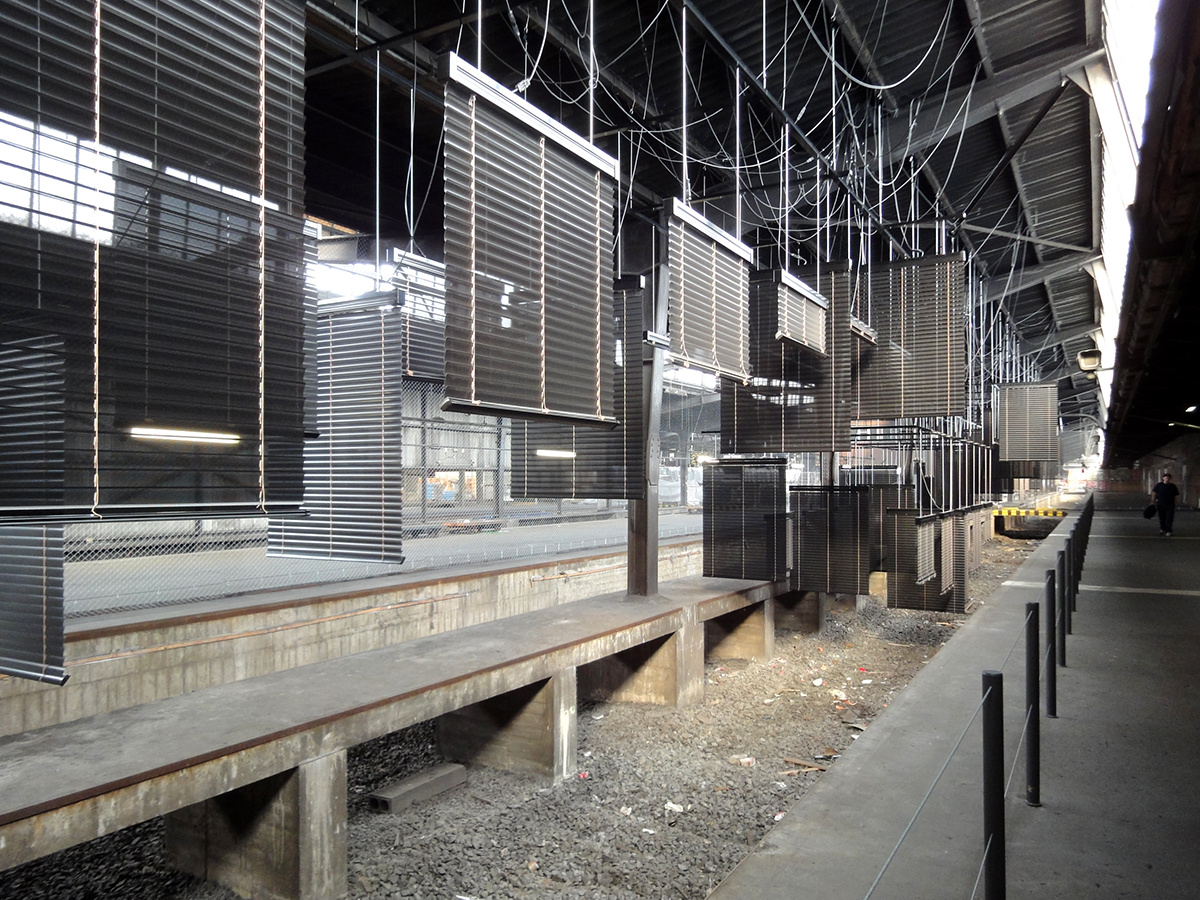
In the northern depot of the Hauptbahnhof, Haegue Yang put up a series of venetian blinds on the abandoned tracks. These motorized blinds moved up and down with slats rotating, performing a ghostly choreographed dance that evoked the place’s industrial past.
Haegue Yang, Approaching. Choreography Engineered in Never-Past Tense

Chicago-based artist Theaster Gates took over Hugenottenhaus – a large old house destroyed in WWII and left empty since the 1970s – and refurbished it with scrap wood he salvaged from abandoned buildings in both Chicago in Kassel, as if to graft his own cultural existence to a German past and to patch up the trauma of war. Aesthetically it reminded me of Gordon Matta-Clark. But it was essentially different because the house was more alive in this case. Gates turned it into an ongoing construction site where furniture was constantly being built, and at the same time a live-in laboratory where talks, music performances, dinner, and Ping-Pong games happened. Gates and his team occupied the house, and the visitors occupied their work. The experience was a rather engaging and voyeuristic act of exploration and discovery.
Hugenottenhaus
Lawrence Weiner’s work on the wall
Theaster Gates, 12 Ballads for Huguenot House

In a very dark room in the backyard of Hugenottenhaus, Tino Sehgal orchestrated another immersive performance piece. About 20 performers sang, danced, clapped, hummed, whispered, and hollered, creating an electrifying experience of free imagination in action. It’s the perfect example of the intangible dimension of art that was celebrated in dOCUMENTA (13). The room was filled with energy just by this series of simple collective activities.
   

Sunday, September 30, 2012

d(13): Huts and a tree

   
dOCUMENTA (13) was massive. It took over the entire city, including various museums, theater, public plazas, park, and the train station, with artworks by 200 artists from 50 countries. The main outdoor venue was Karlsaue Park, a 1.5km² Baroque garden that accommodated more than 40 pieces of the show. To my surprise, many of these works were photographs and videos housed in little prefabricated wooden huts scattered around the park. It didn’t make sense in an open-air context where the sky’s the limit for public art like large sculptures and site-specific installations. Plus, videos and films are the format that requires concentration and patience. Very few people would actually watch them in their entirety, especially at a massive exhibition like documenta.
Joan Jonas’s hut for her video installation

Some artists did take the concept of the freestanding hut and turned it into installations and even institutions. Japanese artist Shinro Ohtake attached objects and scraps onto a hut and made it a means of self-expression. Gabriel Lester created a curved tunnel to explore the moments of change and discovery. Mexican Pedro Reyes continued the Sanatorium he started for the Guggenheim’s Stillspotting NYC program. It was a utopian “temporary clinic” where visitors could sign up for free therapies for contemporary urban malaises: stress, loneliness, anxiety, etc. There were 8 sessions in the d(13) version of Sanatorium: the Museum of Hypothetical Lifetimes, Goodoo (the positive iteration of voodoo), Vaccine against Violence, Compatibility Test for Couples, Ex-Voto (to express gratitude), Philosophical Casino, Cityleaks, and Mudras (hand gesture expressions). Sam Durant’s subject was more intense. What looked like a playground pavilion or a viewing platform in the park was actually a reconstruction of multiple historically significant gallows, ranging from the Lincoln conspirators gallows to Saddam Hussein’s scaffold. They were stacked one on top of another and entangled within each other, forming a caustic anti-monument to the continuing history of death penalty.
Shinro Ohtake, MON CHERI: A Self-Portrait as a Scrapped Shed, 2012
Gabriel Lester, Transition 2012, 2012
Pedro Reyes, Sanatorium, 2011-ongoing
Sam Durant, Scaffold, 2012

There were other more site-specific works that took the park context seriously. Located at the far end of the Hirschgraben, one of the two radial canals, a distorted clock was installed by Anri Sala to emphasize the Karlsaue Park’s central-point-of-view layout. On the other canal the Küchengraben, Swiss artist Christian Philipp Muller built a bridge with standard units of pontoons rented from the THW (the German Technical-Relief Organization), typically used to cross waters in post-disaster situations. On these long narrow barges, he placed potted soil beds of various colorful Swiss chard, turning the floating pontoons into a small farm.
Anri Sala, Clocked Perspective, 2012
Christian Philipp Muller, Swiss Chard Ferry (The Russians
aren’t going to make it across the Fulda anymore)
, 2012


In the middle of Friedrichsplatz next to Karlsaue Park, Kristina Buch planted ideal food plants for indigenous butterfly species on a raised platform. Butterflies populated the flower island through the 100-day duration of d(13), and produced new butterflies, whose empty chrysalises were then collected by the artist and displayed in a glass vitrine at the entrance of the documenta-Halle. On the Karlswiese in front of the Orangerie, Chinese artist Song Dong created a 6m-high mound of lush tall grass and colorful flowers. The mound itself was nothing more then accumulated waste – layers and layers of rubble and biological garbage. Neon signs of Chinese characters on top said “Do for the sake of doing. Done for nothing. Do it even it’s for nothing.” Next to the mound, Massimo Bartolini embedded a rectangular pool into the grass. The water inside swayed rhythmically back and forth. There was obviously a mechanical system behind, but it still looked quite mysterious.
Kristina Buch, The Lover, 2012
Kristina Buch, The Lover, empty chrysalises
Song Dong, Doing Nothing Garden, 2010-12
Massimo Bartolini, Untitled (Wave), 1997-2012

The highlight of Karlsaue was probably Giuseppe Penone’s tree on an open lawn. Barren branches were magically holding aloft a heavy boulder. This seemingly impossible situation drew a big crowd around it. Take a closer look, the tree was actually a hyper-realistic sculpture made from bronze. Installed back in 2010, it was the very first artwork of d(13). It had a sister piece in Kabul, where Penone permanently intervened the growth of a tree by cutting a marble piece into its trunk. The natural and artificial parts would integrate as a holistic entity.
Giuseppe Penone, Idee di pietra (Ideas of Stone), 2003/2008/2012