Monday, May 7, 2012

Milano’12: Things in the city

    
The Milan Salone was way more than just the Fairgrounds. Fuorisalone (literally meaning outside of the fair) happened all around the city, including Zona Tortona, Brera, and the Triennale Museum, to name a few.

The Triennale di Milano mounted their annual Design Week exhibition series for the occasion. French brand Blackbody put up a show titled Wonderoled to explore the potential of OLED technology. Italian designer Alessandro Ciffo presented his Iperbolica series silicon armchairs. With no substructure, these mushy hyperbolic chairs take their final shapes from gravity, consistency of the cast, and the air volume trapped inside.

Blackbody’s Wonderoled exhibition with I.Rain by Thierry Gaugain on the left
Blossoms by CibicWorkshop
Alessandro Ciffo’s Iperbolica

Spazio Rossana Orlandi organized its exhibits around a former tie factory in the Magenta Neighborhood. Things on show here included Italian sculptor Benedetta Mori Ubaldini’s wire mesh (chicken net) objects and Slovenian designer Nika Zupanc’s Summertime lamps that look like huge bubbles. In the courtyard, there was Bocci’s 38 Series by Vancouver-based architect Omer Arbel. These blown glass lamps are well integrated with plants and a mechanical conveyor system.
Spazio Rossana Orlandi
Benedetta Mori Ubaldini’s wire mesh objects
Summertime by Nika Zupanc
Bocci’s 38 Series by Omer Arbel

After the stunning display at Design Miami/Basel last year, Nacho Carbonell continued to be a major feature at Rossana Orlandi. Just upon arrival, one could see the Soft LED Lightbulb Carbonell developed for the Dutch brand Booo, using rubber to contrast the conventional concept of fragile and cold glass bulbs. In the courtyard, the bronze chair Auditorium was sitting quietly. In the staircase, fragments of Silent Wall were hung on the wall – samples for an entire wall made of small soft pieces of pigmented polyurethane foam in the restaurant next door.
Soft LED Lightbulb by Nacho Carbonell for Booo
Auditorium
Silent Wall fragments

Carbonell’s work was also seen in other locations in Milan. At the Tom Dixon curated MOST show, Memoralia stood outside of an exhibition shed. At the Legacy show organized by INTERNI, Carbonell’s Bush of Iron chair had a stunning presence by a staircase.
Memoralia by Nacho Carbonell at MOST
Bush of Iron by Nacho Carbonell at INTERNI Legacy

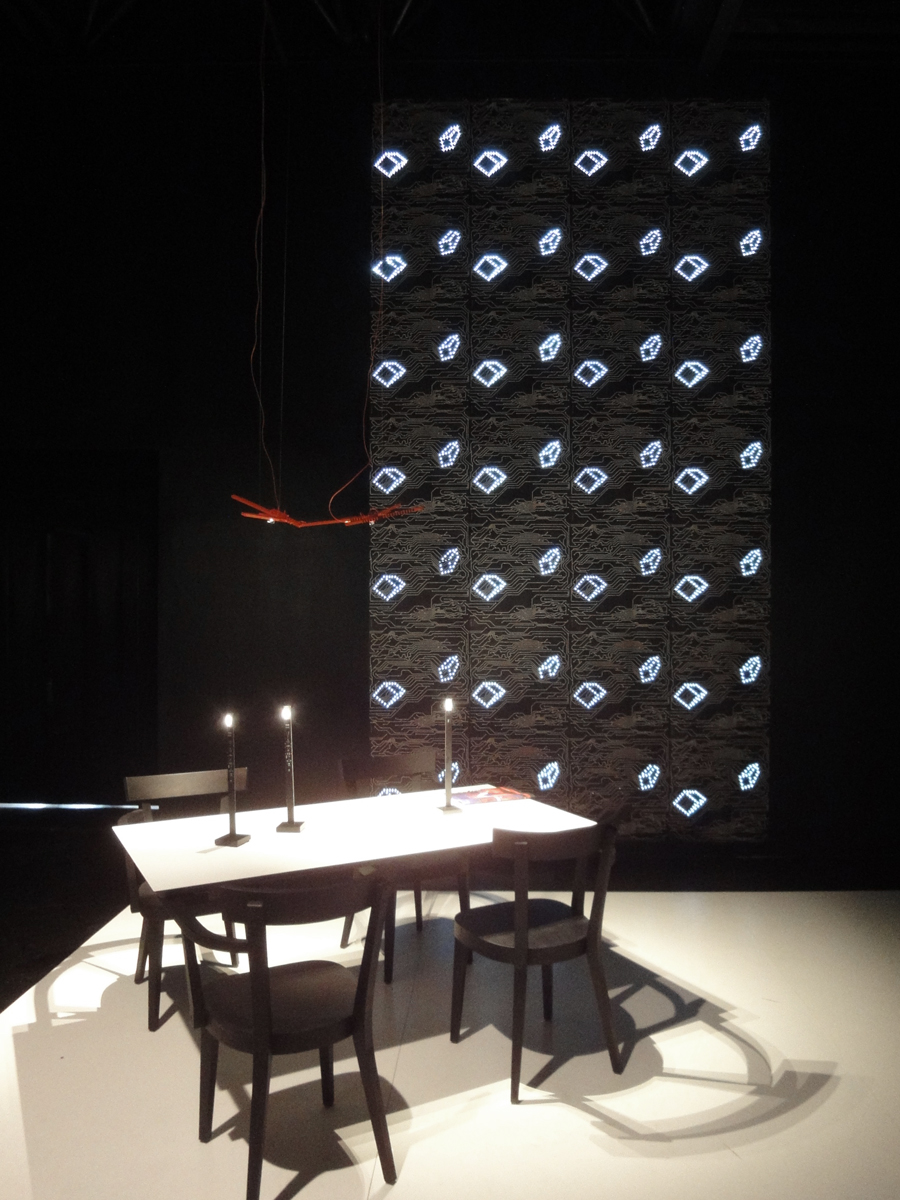
Ingo Maurer, the German designer responsible for my favorite installation at the INTERNI show last year, presented several new works at his solo show at Spazio Krizia. The most eye-catching was an acoustical wall installation called Biotope, featuring green sponge and LED butterfly. Other impressive pieces included Candle in the Wind, a chandelier with flickering digital candle flames, and prototypes of a single LED candle in front of the LED Wallpaper.
Biotope acoustical wall installation by Ingo Maurer
Candle in the Wind by Ingo Maurer
LED Wallpaper by Ingo Maurer

Zona Tortona kept up with its cool and hip buzz this year. Temporary museum, special showrooms, pop-up stores, and of course, street bars and eateries. I spotted this stunning wood casting by Hilla Shamia. Aluminum flows into the cracks of a tree trunk, leaving dark burnt edges that mark the heated synthesis of the two materials.
Wood casting by Hilla Shamia

Bisazza and Established & Sons occupied Area 56 on via Savona. With bright light stripes wrapping around, Established & Sons’ show featured the Aqua Table by Zaha Hadid, the Iris series by BarberOsgerby, Quilt by the Bouroullec brothers, the Cape sofa by Konstantin Grcic, and the soft PVC dipped polymer lamps called Touch Light by Sylvain Willenz. Bisazza launched new bathroom furniture lines designed by Nendo and Marcel Wanders. The Wanders Collection combined the aesthetic of new antiques with the clean shape of a bar soap.
Iris series by BarberOsgerby (left) and Aqua Table by Zaha Hadid (right)
Quilt (middle) by Ronan and Erwan Bouroullec
Cape sofa by Konstantin Grcic
Touch Light by Sylvain Willenz
Marcel Wanders for Bisazza Bagno

Marcel Wanders’s own company Moooi had a showroom a few blocks away. Moooi presented their new collection with the new campaign concept “Inside the Box,” portraying a product almost humanly wrapped by a naked person inside a (gift) box.
Moooi Showroom
Heracleum II LED lamp by Bertjan Pot
Altdeutsche Cupboard by Studio Job

In Brera, Salvatori presented their new finishes and furnishing complements at their showroom. The most impressive was Ron Gilad’s Soft Marble collection. Just around the corner, Dilmos put up a Ron Gilad show for a second year in a row. As implied in the titled “The Line, the Arch, the Circle & the Square,” the exhibition returned to the basic parts a designer deals with. I found it very intriguing to see the small Michael Thonet chairs holding the “56” Day Bed and the “56” Cabinet.
Soft Marble collection by Ron Gilad for Salvatori
“56” Day Bed
“56” Cabinet
Void stools and one of the “IX Mirrors”
    

Sunday, May 6, 2012

Milano’12: Things at the Fairgrounds


There were thousands of exhibitors at the Rho Fairgrounds – no way I could see them all. For somebody as greedy as I am, it could be quite stressful. I made up my mind at the end: next time, I’d better strategize and prioritize, or simply arrive earlier in the day.

From what I saw, it seemed that funny shapes and bright colors were not as omnipresent as last year. But it was still a wide-spread trend, seen in brands from Italy, France, Denmark, and the Netherlands.

Dutch brand Leolux presented its new collection with blown up chandelier
Danish brand Softline’s Rio lounge chair by Busk+Hertzog
French brand Roche Bobois’s Sputnik chairs by Sacha Lakic, in good company with that book there
Campeggi launched iPouf lounge/speakers by Emanuele Magini
An earlier product from Campeggi: Airpouf stool/vacuum cleaner by Lorenzo Damiani
Casamania’s new Chariot is a mobile table with exaggerated wheels on the sides, designed by Gamfratesi

Fabio Novembre designed the 36h and 56h chairs for Driade, using an aluminum structure covered with woven plastic. He named the product after the temporal value each of them requires, in honor of the work of the skilled craftsmen who made them. They look odd, but actually they are quite comfortable. I also spotted the interior line of Sicis Mosaics called Sicis Next Art. It was so over-the-top that it made Fabio look tame. I kept wondering if it was responsible for Princess Beatrice’s hat at the royal wedding one year ago.
Driade’s 36h and 56h chairs by Fabio Novembre
Sicis Next Art

Of course it was not just about shapes. Some nice pieces explored the use of different materials, from the classics to the unexpected.
Glas Italia’s Nezu series by Jasper Morrison is made of a new double-faced
acid-etched glass, tempered and thermo-welded together.
Cor-ten furniture at the De Castelli stand
Univers series by Wolf Udo Wagner for Fischer Möbel uses foam-coating similar to Quinze & Milan’s.
Kenneth Cobonpue’s Cabaret series has thick fabric tubes woven over a steel frame.
Emporium’s Cora and Zoe chairs by Roberto Giacomucci are made from partially melted plastic
from recycling process. They look soft but are actually quite hard.
Mogg presented a dresser that looks like a pile of lumber.
Casamania’s Rememberme chairs by Tobias Juretzek are entirely made from old clothes.
Nani Marquina showed her new Chillida collection, which transforms
the Spanish master’s artworks into high quality rugs.

Many well-known brands took the opportunity to launch their new products. Magis, for example, presented the Pila chairs and the Pilo table designed by the Bouroullec brothers. They showed the designers’ consistent attention to form, materiality, and detail. Pila has a thin plywood seat and back supported on an aluminum frame almost invisible underneath, while Pilo features cast aluminum connectors between the legs and the table top. Marcel Wanders added some wicker-backed chairs to his Cyborg series. There were also Clouds and Birds – hanging sculptures made of metal mesh by sculptor Benedetta Mori Ubaldini, whose work was also shown at Spazio Rossana Orlandi.
Pila chairs and Pilo table by Ronan and Erwan Bouroullec
Aluminum connector under Pilo
Wicker chairs by Marcel Wanders
Clouds by Benedetta Mori Ubaldini

Moroso showed products including the “Successful Living” collection with Diesel. The Moon chairs by Tokujin Yoshioka were shown again, but this year with a brushed metal texture.
Rock series, Diesel with Moroso
Moon chairs by Tokujin Yoshioka

Vitra presented the Grand Repos by Antonio Citterio. I actually found those hard plastic balloons and soft stuffed cactus very interesting.
Grand Repos by Antonio Citterio

Molteni&C launched the Grado° collection by NY-based Israeli designer Ron Gilad. It showed an intricate play with geometry. In the series of wooden and glass tables, he made use of 45° edges, shaving off the corners and softening the cubic shape. The 35° coffee table and 60° sideboard look like open boxes with very elegant thin metal wire frame.
45° tables by Ron Gilad
35° coffee table and 60° sideboard by Ron Gilad

Monday, April 30, 2012

Milano’12: Teaser


Once again, I was overwhelmed by the Milan Salone. I was running around for three days, taking over 1,200 photos of the things I saw at the Rho Fairgrounds and all over the city. The different ways of display were still quite impressive, especially when there was a nation to represent. Japan stood out as a country with outstanding contributions from Issey Miyake and Nendo. INTERNI again occupied the old university courtyards, this time for a show titled “Legacy.” Other blockbuster shows include MOST curated by Tom Dixon and “The Future in the Making” put together by Domus and Audi. Big-shot architects like Zaha Hadid, Jean Nouvel, David Chipperfield, and Tadao Ando all left their marks in Milan this year.

Please be patient while I’m sorting out my photos. Eight posts to come!

Related: Milan coverage last year

Tuesday, April 24, 2012

The iron words

   
Finally watched The Iron Lady. Meryl Streep was absolutely amazing. On top of that, I found the movie full of wise words. Here are some quotes I’d like to share.

Young Margaret Thatcher: For those that can do, they must just get up and do. And if something is wrong, they shouldn’t just whine about it. They should get in there and do something about it. Change things.

Denis Thatcher (referring to home videos of some memorable moments in the past): You can rewind it, but you can’t change it.

Margaret Thatcher the Education Secretary: If the Right Honorable Gentleman could perhaps attend more closely to what I am saying, rather than how I am saying it, he may receive a valuable education in spite of himself!

Margaret Thatcher (when giving her daughter a driving lesson): One must be brave if one is to take the wheel.

Margaret Thatcher (after visiting the US): They are unafraid of success. We in Great Britain and in Europe are formed mostly by our history. They, on the other hand, are formed by their philosophy. Not by what has been, but by what can be. Oh, we have a great deal that we can learn from them.

Airey Neave: If you want to change this party, lead it. If you want to change the country, lead it.

St. Francis of Assisi (quoted by Margaret Thatcher upon arrival at Number 10 Downing Street): Where there is discord, may we bring harmony. Where there is error, may we bring truth. Where there is doubt, may we bring faith. And where there is despair, may we bring hope.

Margaret Thatcher: People don’t think any more. They feel... Do you know one of the great problems of our age is that we are governed by people who care more about feelings than they do about thoughts and ideas? Now thoughts and ideas, that interests me.

Alfred Roberts (quoted by Margaret Thatcher): Watch your thoughts for they become words. Watch your words for they become actions. Watch your actions for they become habits. Watch your habits for they become your character. And watch your character, for it becomes your destiny! What we think, we become.

Margaret Thatcher: Yes, the medicine is harsh, but the patient requires it in order to live. Should we withhold the medicine? No. We are not wrong.

Margaret Thatcher: We will stand on principle or we will not stand at all.


Monday, April 16, 2012

The cult of Steiner

     
The exhibition “Rudolf Steiner – Alchemy of the Everyday” at the Vitra Design Museum is the first major retrospective on the complex man who was all at once a writer, philosopher, sociologist, educator, architect, and artist. I don’t really know much about Steiner’s achievements in such different fields. So it’s a perfect chance for me to learn about his life and work and get a holistic view on the inception and progression of the whole anthroposophical movement that he started.

Worldview
The first room provides an overview of the context where Steiner’s worldview and artistic style were formed upon. Turning of the century, Goethe and German Idealism, late Romanticism and the advent of Modernism, the Lebensreform (“Life Reform”) social movement, etc. Josef Gočár’s desk clock is included as an example of Czech Cubist influence. And there’s a model of Bruno Taut’s Glass Pavilion to show the Durchgeistigung (spiritual permeation) idea of the German Werkbund. It was also the age of evolution theory, microscopy, and X-ray. Organic design works by Antoni Gaudí, Henry van de Velde, Richard Riemerschmid, and Hector Guimard are featured alongside Ernst Haeckel’s groundbreaking book Art Form in Nature published in 1904.

The first room: Context
Josef Gočár, desk clock, 1913
A print from Ernst Haeckel’s Art Form in Nature, 1904

In Steiner’s view, nature consists of four parts: a mineral world, a plant world, an animal world, and the human being. And the human being includes a physical body, an etheric (life) body, an astral (sentience) body, and the ego “I”. His 9m-high wooden sculpture The Representative of Humanity is the perfect illustration of this thinking. The Christ figure – the human existence with “the most sublime principle” – stands free in the center. He is surrounded by different distorted figures of Lucifer and Ahriman – light and dark devils that represent the two polarized traits of our lives. Christ’s gesture with one arm raised and the other lowered suggests an inner state of consciousness, a balanced existence between Luciferic frenzy and Ahrimanic tedium, between expansive pride and contractive insecurity.
A miniature of The Representative of Humanity (1917-25) on show

The anthroposophical society
The anthroposophical approach had influence in many areas of social lives, including education, agriculture, medicine, and social finance.

Steiner founded the Waldorf schools, a pedagogy based on his child development theory and education principles outlined in The Education of the Child in the Light of Anthroposophy in 1907. The approach follows an interdisciplinary curriculum according to “epochs” rather than subjects. It emphasizes the role of imagination and the arts, integrating knowledge with creativity. In 1919, the first Waldorf school was founded to serve the children of employees at the Waldorf-Astoria cigarette factory in Stuttgart. Now there are more than 1,000 Waldorf schools around the world and it has become the second largest group of private schools just after parochial schools.

Anthroposophical farms practice biodynamic agriculture, which sees the soil, plants, and animals as a self-sustaining system. One of the key elements is the exclusion of chemical fertilizers or pesticides. Preparations are made with extracts of certain substances, and their efficacy is enhanced by the observation of cyclic rhythms in nature. This method recognizes and supports natural energy and mechanisms of a healthy balance, and links back to the fundamental worldview of Steiner’s anthroposophy.

It gets a bit more cult-like when it comes to anthropological medicine. The approach incorporated some aspects of homeopathy but defined itself as an extension of mainstream academic medicine. Steiner adhered to Paracelsus’s principle of similitude (“like cures like”): “a poison in the body would be cured by a similar poison.” He was convinced that certain methods could be used to extract the active ingredient from a substance and successively dilute it until a “spirit-like essence” remains (“potentiation”). Yet again, all this has its anthroposophical roots: it is a holistic medical discipline where etheric and astral bodies must be taken into account.

The central social concept of anthroposophy is social threefolding, laid out with a series of essays in The Renewal of the Social Organism (1919-20). The theory suggests a threefold social order: economical, political, and cultural; and the three realms should be relatively independent to form a mechanism where they can mutually correct each other in an ongoing process. Steiner believed that it could be “a third way” between capitalism and socialism. Joseph Beuys’s blackboards installation is featured as a sample artwork that was inspired by this theory of a new society.

Joseph Beuys, Directional Forces, 1977

Art and design
Steiner’s contribution to art was far more than just inspirations. He was himself an artist (as sculptor of The Representative of Humanity) and invented a performing art form called eurythmy. As the Greek root of the name suggests, this expressive movement art emphasizes on the beauty of harmony, both between the performers and the audience and within the performers themselves. It was widely taught at the Waldorf schools as well as performed on stage.

An installation explaining the stage composition of an eurythmy performance

Eurythmy reminds me of Loïe Fuller. In fact, the same fluid language was “frozen” in the form of stage set for one of Steiner’s four mystery dramas, The Guardian of the Threshold. The organic waves created a landscape of spirit and fantasies.
The Guardian of the Threshold, Scene VI (The Spirit World), 1937

Steiner also worked with scientists on geometric research to develop crystalline structures, which became an important part of the so-called “anthroposophical style.” Examples include Carl Kemper’s platonic solids series (1930s) and Paul Schatz’s Oloid discovered in 1929. It reminds me of Olafur Eliasson’s structural studies. The curator obviously also sensed the similarity and included Eliasson’s Before the star lamp in the show.
A showcase with Carl Kemper’s platonic solids (left) and Paul Schatz’s Oloid (far right)

In order to have a headquarters for anthroposophy and a center dedicated to the spiritual sciences and all art forms, Steiner began to build the first Goetheanum in Dornach, Switzerland in 1913. Named after Goethe, the timber-concrete structure opened in 1920, but was soon destroyed by arson on New Year's Eve 1922/23. Right after the accident, Steiner set out to design a second Goetheanum, this time completely made of reinforced concrete (15,000 m3). Construction finished in 1928, after Steiner’s death. It was the first large-scale building to use concrete for such a sculptural form. In the center is a large auditorium with a 30m span that can house 1,000 visitors for eurythmy and mystery dramas performances.
The second Goetheanum, 1923-28

The Organic-Expressionist style is similar to that of Gaudí, Erich Mendelsohn, and Wenzel Hablik. In Dornach, Steiner also designed about a dozen other buildings, including Duldeck House (1915-18), De Jaager House (1921-22), Eurythmeum (1927), and two utility facilities: a boiler house (1913-15) and a transformer house (1921) – all with expressive forms.
Models, with the boiler house (1913-15) on the right
Models, with the transformer house (1921) in the front

As I walk through the exhibition, a voice keeps whispering to me: “you have to go to Dornach.” I am sure it will be totally worth the trip. I will definitely report more after that. Till then...
To be continued...


Thursday, April 12, 2012

Just the little things


Once again, Denmark has been rated the world’s happiest country. This time, it’s a report claimed to be the first ever official study, commissioned by the UN and published by Columbia University’s Earth Institute. Before this, the Gallup World Poll released data in 2010 ranking Denmark the happiest country among the 155 surveyed. In 2008, the World Values Survey by the US National Science Foundation also put Denmark on the top of their most content nations list. And back in 2007, surveys done by Cambridge University and Leicester University both agreed that the Danes are the happiest people on earth.

One can easily give several reasons for this. The Danes are quite wealthy, living in a secure society with almost zero crime and corruption. They grow up with good health care and education systems (they get paid to go to school). After graduation, they work only 37 hours a week (Mon-Thu 7.5 + Fri 7), with 5 weeks of paid vacation per year.

Good systems build up a more civilized society, but they don’t guarantee personal happiness, which is more a subjective emotion or attitude. “It’s probably because we have very low expectations,” my Danish friend Goldie told me. “When it rains, we simply shrug our shoulders. When the sun comes out, we’ll say, ‘wow, this is really amazing!’” Take a look at some of the questions asked by the Gallup Poll: Did you enjoy something you did yesterday? Were you proud of something you did yesterday? Did you learn something yesterday? I guess at the end, it all comes down to the little things people experience every day.

If you are not expecting much, many little things in your life can be wonderful. For the Danes, a few drinks with friends, a sausage on the street, or a dinner with family is enough to make a joyful day. They are proud of their lives and proud of what they have: Danish pastry, Carlsberg, Tivoli, Hans Christian Andersen, Georg Jensen, Arne Jacobsen, Poul Henningsen, Queen Margrethe, Lars von Trier (maybe until Cannes 2011), and Daniel Agger’s tattoos. They joke about the little mermaid being super tiny, but deep down, they love her as the romantic symbol of the kingdom. There are millions of bikes in Copenhagen. If this simple vehicle can take you around perfectly, who needs the newest model of Chevy SUV?

The Danes can find “hygge” in the dark and cold winters through the soft glow of a simple Le Klint lampshade, or the balmy smell of a candle. When summer comes, Copenhageners strip and lie down naturally on the waterfront deck in the middle of the city, sunbathing. Not far from the boardwalk, the Harbor Bath is certainly one of the most popular urban hang-out in the city.


Oh yeah, the Harbor Bath. You know Bjarke. He is so typically Danish and looks always so happy. He acts like a kid, easily psyched about simple, straight-forward, and sometimes even stupid ideas. He has this charisma that can convince anybody that architecture is in fact very simple and fun.

If life is all so simple and beautiful, why do we need ambitions? Georg Jensen and Arne Jacobsen gave their answers through quality: design with close attention down to a single screw or a door knob. Bjarke seems to believe in quantity: do a competition every week and you may win every month. Either way, the little moments of simple pleasure could lead to greater joy at the end.