Thursday, January 15, 2009

Design perversity


Perverse:

- turn away from what is right or good;
- obstinate in opposing what is right, reasonable, or accepted.

Perversity is essentially optimistic since it requires courage to challenge the obvious and the established, and to believe in chances for the otherwise. "What if?" is really Open Mind 101 - perverse designs start from this active thinking. Does the other way around really make sense? Not necessarily, but why not? The "proper" way is not the only way! Plus, who and what define what is right anyways?

Queen Elizabeth, Tibor Kalman, Colors 4: Race

Moving Forest, NL Architects, "Urban Play" Amsterdam

“Ohrensessel” wing chair, Hannes Grebin

“Perser” carpet, Hannes Grebin

Tuesday, January 13, 2009

A good reason to sleep until 10


Cortisol (a.k.a. the stress hormone since it increases blood pressure and blood sugar) peaks in your blood around 7-8am. If you get up then, you may feel stressed. The best solution, is to sleep until later, like 9 or 10, when your cortisol level drops back down. Then you wake up and kick off your day fresh! (Like we usually do in weekends...)

Monday, January 12, 2009

The art of camouflage III - Crypsis


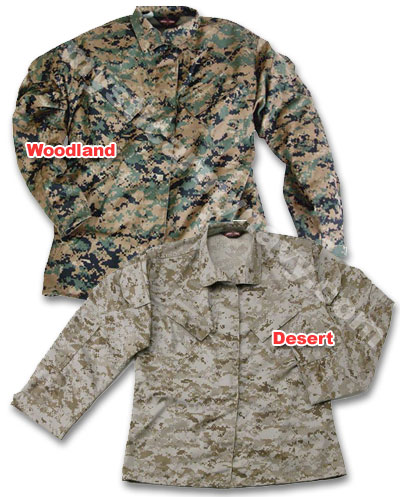
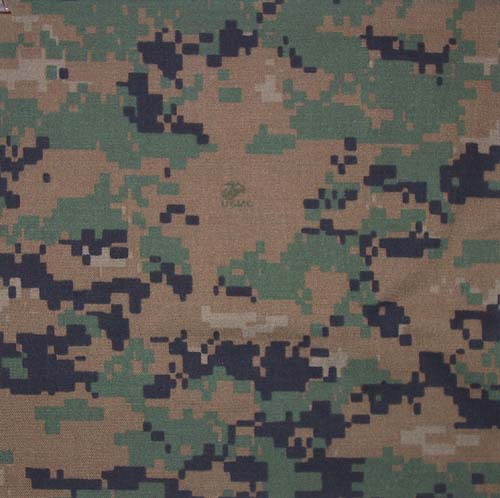
"Blob" M81 Woodland "Pixels" MARPAT

This may be the most well-know type of camo. It is inspired by natural cryptic coloration. The soldiers are not born with skins like those creatures in the woods, so we clothe them.

One very interesting fact is that the camo pattern in the US Marine uniform has become pixelated since 2003. The new pattern looks pretty trendy: it is formed by a number of small rectangular pixels of color. In theory, it is a far more effective camouflage than the traditional patterns because it mimics the dappled textures and rough boundaries found in natural settings. This is caused by how the human eye interacts with pixelated images. It is also known as the "digital pattern" because of its micropattern (pixels) rather than the old macropattern (big blobs).

To reach the final versions of MARPAT (MARine PATtern), the United States Marine Corps design team went through over 150 different camo patterns. The pixels were generated by highly complex fractal equations that result in a non-repeating pattern. Then they narrowed down to three and reconstructed them with new shapes and unique color blends that would allow a more effective uniform in a great range of environments. Before issuance, field tests were required in various environments, wet and dry, day and night, with night vision and various optics. (How do architects make patterns?)

The first pixelated camo pattern was introduced in 1997/98 on the helmet cover by the Canadian Forces. It's called CADPAT (CAnadian Disruptive PATtern).

The art of camouflage II - Conceal


Forgot when and where this was. But it was during some war, an aircraft factory was built and covered by fake grassland and a road, so the enemy fighter jets wouldn't see it.

Did "green roof" just become a trend recently?

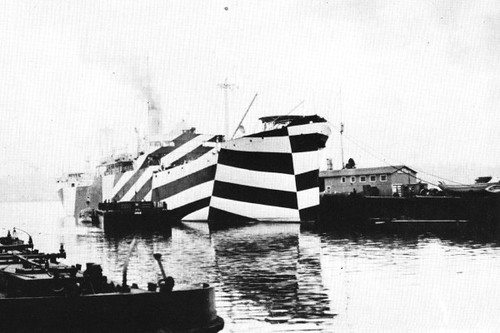
The art of camouflage I - Dazzle


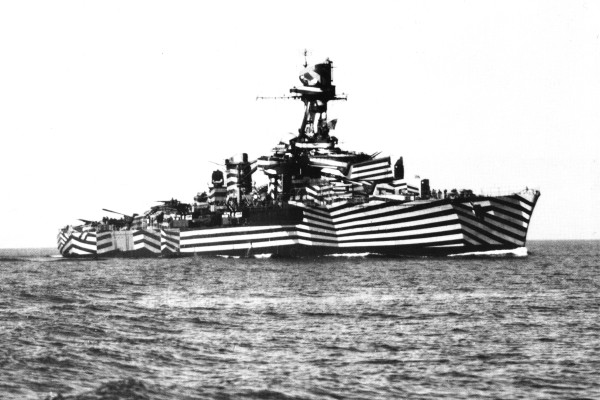
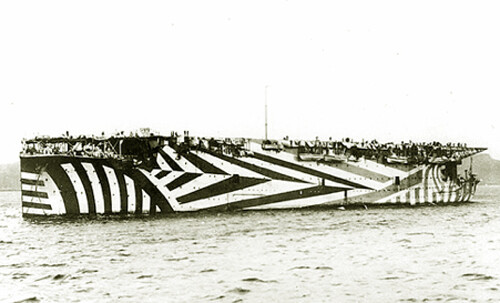
At first glance, this doesn't seem to be camouflage at all - the pattern draws attention to the ship rather than hiding it. But the dazzle technique was developed with the blessing of Gestalt Psychology in early 20th century and was widely adopted by many countries during WWI and WWII.

The purpose is to confuse rather than conceal. The bold clashing pattern disrupts the naval visual rangefinders and makes it difficult for the enemy to estimate the vessel's shape, speed, and heading.

Saturday, January 3, 2009

Fabulous ocean liners


Look at these ships - how fantastic! Varies types/sizes of program spaces are brilliantly fit into this shape engineered for optimal movements. How can OMA patent "cake-tin architecture" (as in TVCC) as an original idea? How can MVRDV claim their sections being innovative?
Look what's inside. They have everything you need for urban life. That's Archigram's "Walking City"!


SS Normandie


Wednesday, December 31, 2008

Swimming Pool


I was fascinated by Leanodro Erlich's Swimming Pool at PS1. Conceived almost 10 years ago, it still looks amazing to me. The main reason, I guess, is that I found it very architectural.

The ordinary and the extraordinary
It is a swimming pool. But it is more than a swimming pool. The "hidden" space underneath has turned a mundane household object into magic. The surreal unexpectedness shakes our understandings of reality. What we take for granted in our everyday life is challenged, defamiliarized, and given another layer of meanings. Oh, I almost forgot, the "reality" we see is mostly constructed anyways.

The object and the non-object
What are we seeing here? The beautifully crafted wood deck? The shiny stainless steel ladder? Or the elegant rounded corners?
None. The art is not the object itself - it is just a stage. It is a stage for a play of participation and interaction. The artist becomes the director. Surprise as an experience, is the result of physical and emotional involvements of the viewer.

The viewer and the viewed
When you think you are watching people on the other side of the thin layer of water, they are watching you as well. This is not a classic case of voyeurism. As a spatial result, what is in and what is out becomes a dialectical question.

Saturday, December 27, 2008

Art patronage now


Jenny Holzer turned the Guggenheim into a giant screen for her projection work. It looks pretty cool. I also found it very funny to read about the real intention behind this commission - the museum wants to show how smooth the newly restored concrete facade is!
OK, maybe this is not funny...


Psychedelia returns


Remember those images from the 60s and the 70s? Exploding Plastic Inevitable? Phantasy Landscape? Pipilotti Rist's Pour Your Body Out (7354 Cubic Meters) at MoMA kind of reminds of those. Yet, the viewers behave differently now - they are just lying down or sitting on the comfortable donut in the middle, no LSD, no sex...

Thursday, December 25, 2008

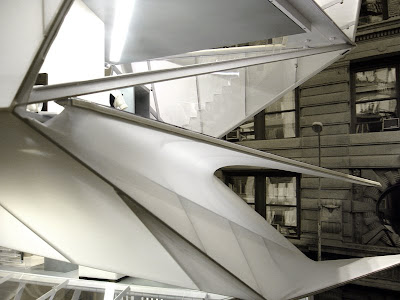
REX's Calvin Klein Dollhouse


A "miniature residence" to display Calvin Klein's spring collection (clothes and furniture).
It will be there at the Calvin Klein Madison Ave store (at 60th St) through Jan 5, 2008.