Showing posts with label books. Show all posts

Friday, June 3, 2011

Urban Editing

        
Heraclitus said, you could not step twice into the same river, for other waters are ever flowing. All things change; our cities are no exceptions. The question is how to understand the changes and how to define the role of design in the process of urban evolution. The latest issue of MONU Magazine "Editing Urbanism" tackles this topic with full power, introducing diverse views from architects, landscape architects, artists, politicians, researchers and theorists. Once again, MONU proves itself to be an interesting and relevant platform for urban discourse.

The term "editing" implies intervention. In the realm of design intervention, we've seen alteration of use and consequently the trajectory of development, like the reactivation of the High Line mentioned in Sean Burkholder's contribution, and OMA's light but powerful revision of the platform in the Bordeaux House. Another type of editing can be to adjust the speed of change. Governments in China and Dubai speed up urban transformation to show their lively visions and ambitions. On the other hand, the fear of dying makes us want to slow down urban decay, prevent any type of changes, or even reverse the flow of time.
The High Line turns an elevated train track into an elevated park.
A large pillow transforms a work space into a relaxation area after the death of the former owner.

We could go quite intensive about this. In The Naked Lunch: A Stark Honest Discussion On Renewal, members of UNION3 talk about overbuilding in Spain and the Netherlands. We can see this in China and Germany as well. Since German reunification, more than 180,000 new residential units have been built in Berlin. But in 2008 the vacancy rate in the city was as high as 10%. This "urban bubble" materialized itself from the optimistic assumption that the new capital could lure big money and rapid population growth.

Another extreme is Venice. Ippolito Pestellini of OMA talks about his experience of working on the Fondaco dei Tedeschi renovation in Extreme Demolition and Extreme Preservation. In Venice, any kind of minor intervention could be against city legislation. This extreme preservation turns a once vibrant city into a touristy "museum" of empty shells - the lack of standard modern urban facilities simply makes it unlivable. What's more worrying is that this extreme preservation trend is spreading throughout the world. According to OMA/AMO's calculation, 12% of the world's surface is now blocked from any potential changes.
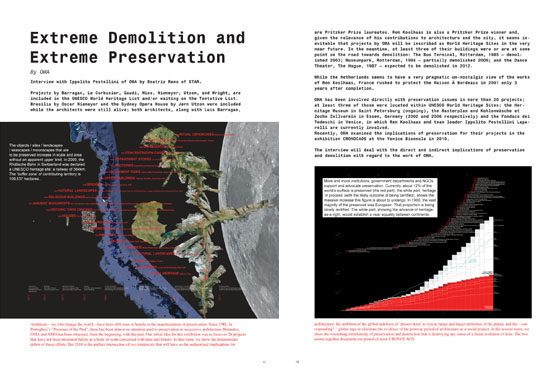
OMA's contribution in MONU #14

The purpose of preservation is to prevent disrespectful or careless alteration. But if it gets to the extreme like Venice, rigid regulations would rule out healthy progressions as well. We know cities adapt and evolve through time. Why do we freeze the moment and stop any type of transformation? Jarrik Ouburg argues in his contribution that the World Heritage status of Amsterdam's canal district may potentially kill the energy of this unique neighborhood. "The city of Amsterdam is praised by the UNESCO because of its town planning and engineering of the past, but will be punished for having the same ambitions for the future." The only future for the preserved district is to be what it was before. This paradox is wonderfully illustrated in Beatriz Ramo/STAR's In the Name of the Past. If the current logics of preservation were applied centuries ago, many of today's monuments, like the Duomo of Florence and the Eiffel Tower, would not even exit.
If UNESCO had existed in 1059, the Duomo of Florence would not be there
because it would obscure the views to Baptistery of St. John. (c) STAR

OMA/AMO brings up another paradox: what if something was designed to change? Kurokawa's Capsule Tower in Tokyo, for example, is facing the danger of demolition. Trying to get the historic landmark status seems to be the only way to save this early 1970s masterpiece. But static preservation is against the original design concepts of the Metabolism movement. Should we respect the abstract ideas or their concrete manifestations?

The biggest contradiction of preservation, in my opinion, is restoration - it reverses the passage of time! STAR compares this operation with the Photoshop retouch of Madonna's Vanity Fair cover. Former Superstudio member Adolfo Natalini further ridicules restoration practices by digging out a surreal image of flooded Florence created in 1972. "If you really want to restore the situation, why just restore to the 19th century? Why not restore the Renaissance situation?" Why not Medieval, Roman, or even Pleistocene situation? "In the Pleistocene situation, Florence was a lake!"

Madonna and her restored youth.
Flooded Florence by Superstudio

Obvious, the notion of decay and death is center to the struggle. As Natalini says in the interview Deadly Serious, "the reason we don't like our physical changes is that they remind us that we are moving closer and closer towards death." In Eternal Ise, Ouburg points out that the interesting rebuilding cycle of the Ise Shrine in Japan may be UNESCO's antidote. Since 690 AD, the shrine has been rebuilt every 20 years. The site is divided into two halves: one is the current building in use and the other is where the shrine was 20 years ago and will be in 20 years. This life and death cycle is like the rebirth of phoenix - a dynamic eternity. But of course, the reborn building is too new to be a World Heritage according to UNESCO's standards.
The self-replicating Ise Shrine

With all the struggles and paradox, the role of architects has become less and less significant in reshaping our built environment. Starchitects who make flashy icons are prominent within the profession, but very few of them are regarded as credible public figures. OMA/AMO points out that since Philip Johnson in 1979, no architect has appeared on the cover of Time magazine. In fact, I found it extremely ironic to see Zaha Hadid in the category of "thinker" alongside Steve Jobs and Sonia Sotomayor in the 2010 Time 100.
The public credibility of architects

In order to regain leadership in guiding urban transformations, UNION3 advocates for a new role of urban curatorship. Designers should understand the life of city and architecture and manipulate it with the right tools and forward thinking. This reminds me of Constant's New Babylon. What the designer provides is a completely re-arrangeable platform instead of a fixed settlement. It's a "dynamic labyrinth" where the inhabitants drift around, endlessly reconstructing the atmospheres of the spaces according to the moment of life. The continuity of a network allows mobility and its open-endedness (or open-mindedness) fosters spontaneous urban editing. As Burkholder argues in What not to Do: A Case for Design Neglect, "in a dynamic system, doing nothing is doing something." Designers can just "present signals of human intentionality and let the system do the rest." At the end, I guess the Taoist paradigm was right: to govern by doing nothing.
New Babylon by Constant

Saturday, May 21, 2011

E-books or p-books?

    
Amazon announced on Thursday that they are selling more e-books for Kindle than print books (p-books) - hardcover and paperback books combined. Since April 1, 2011, Amazon has sold 105 e-books for every 100 print book. That includes sales of hardcover and paperback books that have no Kindle edition, and not counting free Kindle downloads. This is not even four years since Amazon started the Kindle business in November 2007, and less than one year after they announced that e-book sales surpassed hardcover book sales last July.

This is definitely a significant milestone. But to be honest, I haven't really figured out how I feel about this. I love the physical existence of p-books (hence also known as "real books"). There is the irreplaceable intimacy of feeling it as an object: look, touch, and sometimes smell the fresh ink. But I enjoy my iPad a lot as well. E-books are compact, lightweight - convenient to carry around. They are cheaper and you can get them right away, in the comfort of your own home or on the go. But it's always fun to physically be in bookstores and browse around real books. You can flip through the pages and get a quick idea about the content. It's easier to write notes on the margin of p-books, but e-books are easier to search and the highlight function is really powerful. And the built-in dictionary allows you to check out definitions of words with just one touch.

The most amazing thing about e-books for me is the interactive dimension of the format. Many magazines embed multimedia materials like slideshows, audio and videos in their digital edition, enriching the experience of reading and 
revolutionizing what we perceive as the publishing industry.

It may look ridiculous nowadays to carry scrolls of papyrus around. But some of them have survived the evolution of technology because they contain valuable original knowledge. Continue this thinking of the basics, both p-books and e-books allow you to do the most important thing - to read a book. The essence is the content. Maybe it doesn't really matter so much what form it takes.


Friday, February 25, 2011

Found humanity

  
Totally unplanned, I went to the Davy Rothbart event at the CAC when I visited Cincinnati. Davy is the creator of
FOUND Magazine, a yearly publication that collects discarded notes, letters, memos, written chats, doodles, etc. At the CAC, Davy hit the audience with one after another funny notes picked up from various cities, seasoning them with his energy and extraordinary reading skills. The event turned out to be two sweet, hilarious, and amazing hours well spent between some art and a fancy dinner.

It all started after one snowy winter night in 1999 when Davy went to his car and found a note on his windshield. It was addressed to another guy named Mario:

Davy was fascinated by this mixture of hate and love. There was clearly a love triangle but Amber was still somehow hopeful at the end. With this passion, he set out to collect more found stuff and made it into a magazine. Then the readers started to send in their finds as well. After a decade, FOUND has become almost like a cult that worships little scraps of paper.

Here's one that seems to be a monthly budget typed up by a neat person. The list starts with rent 600, cell phone 50... food 500, liquor 600 (!), and... crack 600 (!!)... Another one is a comparison made by a woman trying to decide between two men. Andrew or Paul?


After a good laugh, I realized it was more than just something funny. We humans have all sorts of emotions, sometimes conflicting ones (like Amber). It's interesting to see how people would/could think and how they decide. These found notes give glimpses into other people's personal and intimate moments. As Davy's mom puts it, it's like "people watching on paper." The notes were written without any self-consciousness or pretense, since they were not meant to be public. So they reveal humanity in a rather raw and unfiltered manner. Through these notes, we can get a sense of all the kinds of lives being led around us, even if we don't necessarily connect with each other on a daily basis or in meaningful ways.


Davy saved his all-time favorite find to the end. I think it's about friendship. (Video found online, taken from another event.)


Tuesday, December 7, 2010

Destructive construction

        
Jonathan Safran Foer's latest book "Tree of Codes" is truly a piece of art. The author took Bruno Schulz's "The Street of Crocodiles," his favorite book, and started to take out words from the text and constructed a compelling new story with the remaining words. The act of writing thus became an exercise to construct through destruction, to create through erasure. The result is as much a sculpture as a work of fiction, a book of cutout pages on which holes indicate traces of the missing words. You then mentally piece together the fragmented phrases and sentences into a coherent narrative.


In a way, this delicate object revives the intimate relationship between the reader and the book - as Olafur Eliasson (who has also cut a book) puts it, "an extraordinary journey that activates the layers of time and space involved in the handling of the book and its heap of words." It is a book that "remembers it actually has a body." Apparently, this emphasis on physicality is a slap in the face of digital books. (Did I just say that on the day when Google launched their ebook store?) The experience of reading involves the texture of paper, the smell of ink, holding the page with your hand and physically turning it. "The Tree of Codes" reclaims the art of the book.

JSF skillfully turned a collection of short stories into one single haunting novel. But does it count as his work if he's literally just using Bruno Schulz's words? In an interview, he said, "There’s the sense that every book ever written is like this, if you use the dictionary as a starting point. This is a more limited palette, but it’s the same idea." This reminds me of a scene in the movie Flash of Genius. It's based on the story of Robert Kearns, professor and part-time inventor, who originally came up with the design for the intermittent windshield wiper and battled to the victory of the classic patent infringement cases against Ford and Chrysler. When Ford’s lawyers claimed that Kearns only used basic electronic components and did not really invent anything new, Kearns used the book “A Tale of Two Cities” to argue that Dickens did not invent any new words yet he did create a unique masterpiece by arranging words into a new pattern. I guess it's the same when musicians compose notes, painters draw lines, and architects punch a window. In the act of creating, we don't really start from scratch every time. We stand on the shoulders of giants.
      

Sunday, December 5, 2010

Spomenik: propaganda or pure beauty?

   
Recently, I spotted a book by Belgian photographer Jan Kempenaers called "Spomenik: The End of History." There are 26 photos of 25 weird but powerful structures, seemingly under poor maintenance, standing eerily on completely deserted lands. They are usually of gigantic scale and abstract geometry, resembling flowers, mushrooms, crystals, or blown-up micro-organisms. Most of them were built with concrete or stone, while some others with metal cladding or partly glazed. They make you wonder: what are these things?

Spomenik #1 (Podgarić), 2006
Spomenik #2 (Petrova Gora), 2006
Pomenik #3 (Kosmaj), 2006
Spomenik #4 (Tjentište), 2007
Spomenik #5 (Kruševo), 2007
Spomenik #6 (Kozara), 2007
Spomenik #7 (Grmeč), 2007
Spomenik #8 (Ilirska Bistrica), 2007
Spomenik #9 (Jasenovac), 2007
Spomenik #10 (Sanski Most), 2007
Spomenik #11 (Niš), 2007
Spomenik #12 (Košute), 2007
Spomenik #13 (Korenica), 2007
Spomenik #14 (Knin), 2007
Spomenik #15 (Makljen), 2007
Spomenik #16 (Tjentište), 2007
Spomenik #17 (Kolašin), 2009
Spomenik #18 (Kadinjača), 2009
Spomenik #19 (Mitrovica), 2009
Spomenik #20 (Brezovica), 2009
Spomenik #21 (Kamenska), 2009
Spomenik #22 (Ostra), 2009
Spomenik #23 (Sisak), 2009
Spomenik #24 (Nikšić), 2009
Spomenik #25 (Sinj), 2009
Spomenik #26 (Zenica), 2009

Spomenik literally means monument. These structures were commissioned by former Yugoslavian president Josip Broz Tito in the 1960s and 70s to commemorate sites where WWII battles took place (like Tjentište, Kozara and Kadinjača), or where concentration camps stood (like Jasenovac and Niš). They were designed by different sculptors (Dušan Džamonja, Vojin Bakić, Miodrag Živković, Jordan and Iskra Grabul, to name a few) and architects (Bogdan Bogdanović, Gradimir Medaković...), conveying powerful visual impact to show the confidence and strength of the Socialist Republic. In the 1980s, these monuments attracted millions of visitors per year, especially young pioneers for their "patriotic education." After the Republic dissolved in early 1990s, they were completely abandoned, and their symbolic meanings were forever lost.

From 2006 to 2009, Kempenaers toured around the ex-Yugoslavia region (now Croatia, Serbia, Slovenia, Bosnia and Herzegovina, etc.) with the help of a 1975 map of memorials, bringing before our eyes a series of melancholy yet striking images. His photos raise a question: can these former monuments continue to exist as pure sculptures? On one hand, their physical dilapidated condition and institutional neglect reflect a more general social historical fracturing. And on the other hand, they are still of stunning beauty without any symbolic significances. I know this may sound schizophrenic if you also read my last post. But maybe there are forms that can transcend meaning...
          

Saturday, October 16, 2010

The true reality


In his new book The Grand Design, Stephen Hawking tells the story of goldfish bowl ban in the Italian town Monza. The town council official Giampietro Mosca explained the reason: "A fish kept in a bowl has a distorted view of reality... and suffers because of this." Hawking asks, "The goldfish's picture of reality is different from ours, but can we be sure it is less real?" He goes on and suggests that reality is basically the observer's mental model. Since it's impossible to remove the observer from the perception of the world, it is pointless to ask whether a model is real, only whether it agrees with observation. Hawking calls this view model-dependent realism.

Reality varies from one person's perception to another. What seems to someone as something just happened naturally may be seen as the nastiest betrayal by someone else, like in the recent much-talked-about facebook movie (a.k.a The Social Network). Many reviews say the story is quite distorted and the real Mark Zuckerberg is not that arrogant and desperate for attention. But we have to know that this movie is based on the book The Accidental Billionaires by Ben Mezrich, and Mezrich's primary source was Eduardo Saverin - Zuckerberg's best friend at Harvard and later the victim of a facebook financial dispute. This is Saverin's side of the story, and of course it won't quite match Zuckerberg's narration if he makes one. I bet the Winklevoss twins would tell something different too. As screenwriter Aaron Sorkin told Time, "There were a number of different versions of the truth coming from three or four or five people... Everybody has their own version, and everybody is right, and everybody is wrong." When it comes to Hollywood storytelling, it's just like what the second-year law firm associate says in the movie, "85% of it is exaggeration, and the other 15% prejury."

What did Mark Zuckerberg say about this? "It's a movie, it's fun." The movie is labeled as a drama so it's understandable that the events were dramatized. But when we talk about documentary, it's another story. Casey Affleck has become another recent talking point after he confessed that his new movie I'm Still Here is actually fake. When released, the film was announced as a documentary that followed Affleck's brother-in-law Joaquin Phoenix on a descent into celebrity disintegration. But in fact, every single bit of it was acting. They hired actors and there were multiple takes. Where is the supposed honesty of a documentary film? Genre suggests expectation. If they said in the first place that the movie was a drama and the scenes were all staged performances, at least I would say Phoenix is a good actor. But now? I will just call it a lie.

Left: Eduardo Saverin (Andrew Garfield) and Mark Zuckerberg (Jesse Eisenberg) in The Social Network; Right: Joaquin Phoenix (Joaquin Phoenix) in I'm Still Here

Casey Affleck defended himself with a quote from Picasso: "Art is the lie that tells the truth." But what did Picasso actually mean by that? We all know a portrait is not the real person; a landscape painting doesn't contain real trees. But there's a difference between being real and being true. Art is true in the sense that it shows the artist's observation of the subject and it tells the artist's version of reality. A Cubic painting represents an attitude totally different from, say, lip-syncing. When Ai Weiwei covered the floor of the Turbine Hall at Tate Modern with more than 100 million handmade porcelain sunflower seeds, he didn't pretentiously go around and tell people those were real sunflower seeds. Instead, he was rather true to the facts and open about the fabrication process in the Chinese city of Jingdezhen. The seeds express Ai's view towards the phenomenon of "Made in China," and his association with China culturally, politically, and economically. The seeds are not real, but the art is true.

Ai Weiwei, Sunflower Seeds (at Tate Modern), 2010

Ai's Sunflower Seeds are sculptures of seeds. They look like seeds but they are NOT seeds. Some say, "Who cares whether they are real or fake? They look like real." I found this line of thought quite post-modern. "Look like something" doesn't mean "it is something." Maybe that attitude is the reason why people can be perfectly content with gypsum half Greek columns attached to a plaster white wall.

In Seven Lamps of Architecture, John Ruskin categorized direct falsities in architecture into three basic types: 1) structural deceits (e.g. steel structure that pretends to be stone or wood); 2) surface deceits (painting or cladding that confuses the reading of materiality); 3) operative deceits (false manufacturing process). Set aside the old-fashioned despise of iron and machine work, the bottom line of the argument is that if something in architecture is trying to look like something else, it is a lie. He elaborated with examples: the delicate fan tracery on the ceiling of Milan Cathedral is a deceptive act of painting, while the Sistine ceiling is no deceit because Michelangelo was not trying to trick you into the belief that God and Adam were actually up there.

Left: Milan Cathedral, tracery pattern painted on the ceiling; Right: Sistine Chapel

And there is also the issue of expectation, like the drama of The Social Network vs. the "documentary" I'm Still Here. In Ruskin's opinion, gilding in architecture is no deceit because nobody would actually expect the building to be made in gold; while in jewelry it is, because it could be understood for real gold. In general, we tend to believe rather than disbelieve (especially when it comes from our dear friends and loved ones), because honesty is regarded as a moral norm in our society. When someone makes a fake that very few can tell, it may be because the trick of counterfeiting is so well performed, but largely it is just taking advantage of people's common expectation for truth. One doesn't get credit by telling convincing lies. Rather, it is a narcissistic pretense to think that making oneself believed is more important than telling others the truth.

Kant said, "without truth, social intercourse and conversation become valueless." Deceit shatters the human intuition of trust. We can't even be confident in our ability to distinguish truth from falsity any more. When discover an untruthful part, we start to cast a suspicion upon the whole thing, and then even question the credibility of the person himself. Let's go back to Casey Affleck. Will you be fully convinced if he tells you he will make a real documentary film next time? Another frustrating thing about deceit is that it interferes with our effort to apprehend the true state of affairs, and therefore impair our judgments. With misleading information, we cannot situate ourselves correctly, nor can we make the fair apple-to-apple comparison. We may say things differently if we had the knowledge of the truth. Dishonesty and pretense are not merely playful jokes. It's utterly disheartening to find out all the things you built your assessments upon were not true.

Everybody encounters different constraints and difficulties in life. From time to time you find yourself in a situation that nobody else can fully comprehend. So it's natural that people construct different models of reality and base their decisions and actions on them. But being true is absolute. To maintain integrity and credibility, you must get the facts straight. No matter what actually happened between Zuckerberg and Saverin, neither of them would go all the way to claim that he alone invented facebook.
   

Monday, September 27, 2010

Important engagement

       
There are many differences in our world. Politics, cultures, personalities... They all have very different opinions and values. At the Al Manakh 2 launch event at Columbia last Friday, Rem Koolhaas situated the research on the Gulf region in the global political context, and argued that the topic of the Middle East is still extremely relevant and remains a very important engagement. He advocated, "the different political systems need a continued commitment to communicate."


Unfortunately, they are not talking. 911 and the current economic crisis were cited by Rem as events that made the US and Europe turn their backs to the rest of the world. Sorrow turned into anger and bias, and the narrow-mindedness stirred up our societies with controversies like the Danish cartoon, Swiss minarets ban, WTC mosque protests, and the stupid Koran burning proposal. Arrogance comes from ignorance. And the refusal to communicate only makes the sad misunderstanding even worse.


Rem was clearly annoyed by the fact that this ridicule even appears on an intellectual level, when he quoted Joshua Hammer's description of Dubai in his review in The New York Review of Books: "Here, Americans stick with Americans, Brits stick with Brits, Indians with Indians. Everyone keeps to his own kind." Rem said, "He wrote this critique as if its different everywhere else... In fact, when I was in Dubai, I experienced a level of social mixture that even this room can't compare."

In this context, Al Manakh 2 is a valuable attempt to understand. If Al Manakh 1 was an academic observation from the outside, this second installment is more a down-to-earth version trying to form an inside-out perspective. It features a collection of 140 essays, mostly written by local authors reflecting on their own situation and expectations. In a way, this has broadened the notion of research in our field to a rather open-minded and open-ended process of curation.

After American journalist Daniel Pearl was brutally murdered in Pakistan in 2002, his widow Mariane Pearl turned sorrow into strength. It was not strength to seek revenge but to continue Pearl's mission, to address the root causes of his death. She and the family formed the Daniel Pearl Foundation. The homepage of their website states: "The foundation's mission is to promote cross-cultural understanding through journalism, music, and innovative communications." This reminds me of a quote from Thomas Szasz: "The stupid neither forgive nor forget; the naive forgive and forget; the wise forgive but do not forget."

Related: Notes: "Al Manakh 2" debate 12/12/09
         

Sunday, June 20, 2010

Fat tails


Reading Niall Ferguson's narration on the history of finance, I saw many almost con-like well-planned inventions that have advanced the system of money to more sophisticated levels, and at the same time devastating moments of human spontaneity that shook our world with bubble bursts and crises. The stock markets, for example, are mirrors of an amplified tendency of overreacting. When prices start to go up, people rush to go in and buy more as if possessed by a collective euphoria - what Alan Greenspan called "irrational exuberance." But if any bad news surfaces, people can flip overnight from greed to fear, selling and withdrawing, causing a dramatic plunge on a global scale.

In statistics, the graph of a "normal distribution" looks like a classic bell curve, with higher probability clustered around the mean and fewer instances towards the extremes. Many natural and physical phenomena, such as human heights and laser light intensity, seem to follow this principle. But the movements of stock market prices are more results of human emotional volatility than rational science of "normal." Prices can surge up steeply one day, and drop with extreme abruptness the next. Statisticians call this distribution with higher likelihood at the extremes "fat tails."

Fat tails imply risks. Things can go extraordinarily well, or terribly wrong. And it's hard to predict. Today you have a winner, and tomorrow you could have a crisis. Impulsive decisions and mood swings push things to extremes, jumping inconsistently between one end to an other. It is almost impossible to understand or follow or react. That's why the rocket science of the Black-Scholes pricing model did not succeed. Maybe the only way to deal with subjective irrationality is guesswork, which by definition gives you 50% chance.

Some say stress or anxiety is the source of poor decisions. People under stress may swing between the poles of mania and depression, suffer from perceptual narrowing that prevents them from seeing the big picture, dramatize trivial happenings that should be expected normally, or even distort reality through denial and fabrication. Is there a way to pull the fat tails back to the mean? I would say: "Calm down."

Tuesday, February 9, 2010

The plurality of perfections


In a 2004 article from the New Yorker (recently featured in the book What the Dog Saw), Malcolm Gladwell mentioned a story about Howard Moskowitz, an American market researcher, who received the task of figuring out the perfect amount of sweetener for Diet Pepsi. Pepsi knew that anything below 8% was not sweet enough and anything over 12% was too sweet. So Moskowitz logically set up experiments to give people batches of 8%, 8.25%, 8.5%, and on and on up to 12%. Instead of showing a concentration that people liked the most, the data were a mess - there wasn't a pattern at all. Then he realized people have different definitions of what's perfect. Rather than search for human universals, they should provide variations. "There was no such thing as the perfect Diet Pepsi. They should have been looking for the perfect Diet Pepsis."

The plural nature of perfection implies variations, and opposes hasty simplification. Sometimes I heard comments like "this will be perfect for China." What does that even mean? Extravaganza? Labor-intensive constructions? Or Feng-shui? (Stereotype is such a curious combination of generalization and specification.) Situation varies, so does "what fits in there." Rem's Maison à Bordeaux was perfect for a man who was confined to a wheelchair. But after he died in 2001, the moving platform became a constant reminder of his absence. His daughter couldn't live there any more.

The idea of plural perfections embraces difference, and facilitates co-existence. At the end it can lead to a colorful world of rich heterogeneity. This can be big as religion, politics, race, and gender, or small as how you want your coffee. There's not necessarily one best way to do things. Why can't we just listen and stop fighting? Why can't we try to understand different opinions instead of biasedly dismiss them right away? Why do we force everybody to like what we like and suppress all the other voices? Yes, you are right. But that doesn't mean others are all wrong.

Monday, January 19, 2009

Architects vs. Prostitutes


Back in China, friends used to joke about architects being like prostitutes: they are both service professions and can only do what the clients tell them to.


Here's a little quote from the book Freakonomics: A Rogue Economist Explores the Hidden Side of Everything, which tells us architects and prostitutes are in fact treated differently:

There are four meaningful factors that determine a wage:
1. how many people are willing and able to do a job;
2. the specialized skills a job requires;
3. the unpleasantness of a job; and
4. the demand for services that the job fulfills.

"The delicate balance between these factors helps explain why, for instance, the typical prostitute earns more than the typical architect. It may not seem as though she should. The architect would appear to be more skilled (as the word is usually defined) and better educated (again, as usually defined). But little girls don't grow up dreaming of becoming prostitutes, so the supply of potential prostitutes is relatively small. Their skills, while not necessarily "specialized," are practiced in a very specialized context. The job is unpleasant and forbidding in at least two significant ways: the likelihood of violence and the lost opportunity of having a stable family life. As for demand? Let's just say that an architect is more likely to hire a prostitute than vice versa."