
In the Art Basel survey, one question was: what discoveries did you make this year? I listed three: the Cuban collective Los Carpinteros, Finnish duo Grönlund - Nisunen, and the British-educated Italian Francesco Vezzoli. Interestingly, they loosely represent three distinct yet overlapping lines of work in contemporary art: humor, delicacy, and homage.
Just as last year, the most impressive piece from this year’s Art Parcours was located in a church. Unlike typical Catholic churches, the Predigerkirche in St. Johann has no pews but instead rows of single chairs. Los Carpinteros’ intervention was to dress 150 chairs with handmade costumes. From a young boy to a carpenter to a businessman to a housewife, these outfits depicted the diversity of those who entered the church, expressing individuality within collectivity. This playful yet powerful installation operated at the intersection of art and society, successfully merging architecture, design, and sculpture in an unexpected and humorous way.
 |
| Los Carpinteros, 150 people, 2012 |


Since they started their collaboration in 1991, Havana-based artists Marco Antonio Castillo Valdés and Dagoberto Rodríguez Sánchez have produced many intricately crafted and humorous installations. In 1994, they adopted the name Los Carpinteros (The Carpenters), deciding to renounce the notion of individual authorship and refer back to an older guild tradition of artisans and skilled laborers. In the Messe halls, Galeria Fortes Vilaça presented two of their maple bookshelves. Are these practical or useless? What’s with the dated notion of form vs. function? There were also watercolors in both Fortes Vilaça and Sean Kelly. The fantastic architecture in the drawings challenged the boundary between the local and the universal, reality and absurdity. And at the end, they were fun!
 |
| Los Carpinteros, Estanteria I, 2010 |
 |
| Los Carpinteros, Estanteria III, 2010 |
 |
| Los Carpinteros, Torre de Control Almendrada III, 2012 (left) Tanques de agua múltiples, 2012 (right) |
 |
| Los Carpinteros, Granero con Centro Infectado, 2011 |
This sense of humor could be seen quite often in art, from Roman Ondák’s door closer and Adam McEwen’s roller shutter to Rogelio López Cuenca’s “absence” painting at Art Basel and Ruth Ewan’s metric clock at the Liste show. Photography works included South African artist Robin Rhode’s photo sequence and Argentinian artist Luciana Lamothe’s play of perspectives.
 |
| Roman Ondák, Open Corner, 1997 |
 |
| Adam McEwen, Rolldown Gate, 2012 |
 |
| Rogelio López Cuenca, Copy W/B, 2011 |
 |
| Ruth Ewan, From “We could have been anything that we wanted to be,” 2011 |
 |
| Robin Rhode, Broken Windows, 2011 |
 |
| Luciana Lamothe, Perspectiva, 2012 |
Artists also like to play with the human figure. It was not the first time I’ve saw Spanish sculptor Bernardí Roig’s fat man doing all sorts of weird things. This time he was licking a light bulb. You would be wondering how he was hanging there as much as Tony Matelli’s Josh was floating (or a split second from touching the ground from a fall, depending on how you see things). The most eerie thing in Art Basel though was a silicon self-portrait by Evan Penny. It was leaning from a wall, hyper realistic (almost like Ron Mueck) but completed distorted. From one angle it looked OK but it got super ghostly from another. It attracted quite a crowd of spectators.
 |
| Bernardí Roig, Practices to Suck the Light (Hanging Man), 2012 |

 |
| Tony Matelli, Josh, 2010 |

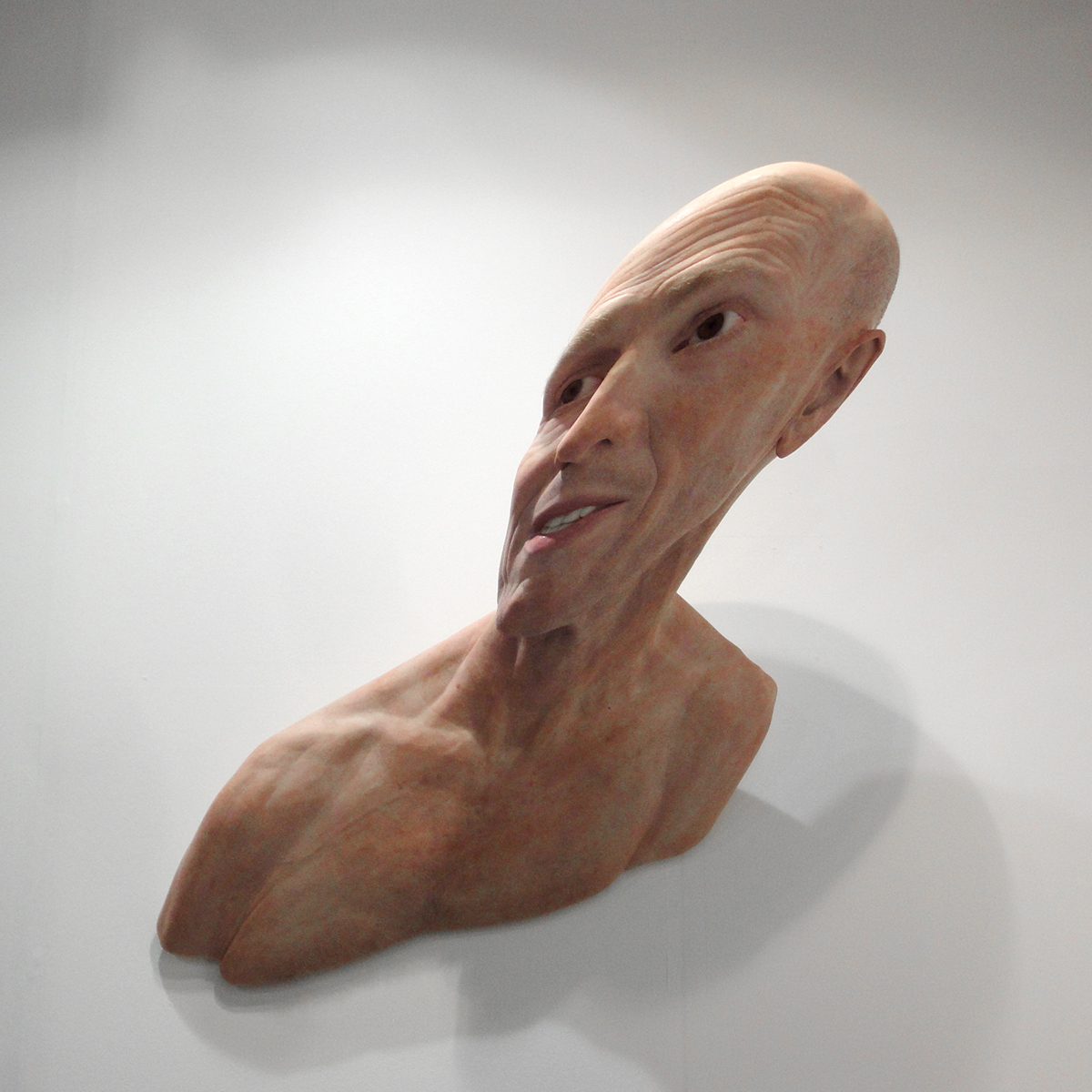 |
| Evan Penny, Self, 2012 |


Another viewer attractor was Grönlund - Nisunen’s Flux of Matter. It was a simple long plate containing thousands of small steel balls, which moved back and forth on the smooth surface as the plate (barely visibly) tilted from one side to the other. It was just simple physics really. But it was mesmerizing. Who would imagine they could be just watching balls rolling around for 15 minutes? It was the movements and the patterns, formed by the balls in a both rhythmic and unpredictable way. More importantly it was the sound: tidal waves at the beach or the unbearable silence before the next storm.
 |
| Grönlund - Nisunen, Flux of Matter, 2012 |

With backgrounds of architecture, industrial design, and also record producing, Tommi Grönlund and Petteri Nisunen formed the creative partnership in Helsinki. Delicacy in their work came from the sense of Nordic simplicity with a touch of magical dynamics, triggering the “nice” and “wow” factors at the same time. Another Grönlund - Nisunen piece featured at the Galerie Anhava stand was Mirror Image. At eye level, metal weights linked with wires from top and bottom were almost touching each other, but they stood still with a gap in between. Oh, they must be magnets! The magnetic field was holding the bottom wires straight up and keeping the upper wires from swaying. Subtlety could be utterly powerful!
 |
| Grönlund - Nisunen, Mirror Image, 2012 |

Zilla Leutenegger was another artist with a delicate sensibility. The Swiss artist’s signature was to combine projection with real objects and drawings. The result was a perfect co-existence of motion and stillness, tension and ease.
 |
| Zilla Leutenegger, Ring of Fire, 2012 |
 |
| Zilla Leutenegger, At Night, 2009 |

Delicacy is material, it’s light, and it’s construction. Wolfgang Tillmans found soft light and color in a simple paper roll. Japanese artist Chiharu Shiota surrounded a chair with intricate web-like black threads while Egyptian artist Moataz Nasr constructed a traditional tent pattern with 24273 matches. At Liste, Andy Boot made delicate “drawings” with gymnastic ribbons cast in wax.
 |
| Wolfgang Tillmans, Paper Drop (Spring), 2011 |
 |
| Chiharu Shiota, State of Being (Children’s Chair), 2012 |

 |
| Moataz Nasr, Khayameya, 2012 |

 |
| Andy Boot, Untitled series, 2012 |

On the other end of the spectrum, Francesco Vezzoli’s work seemed rather flamboyant. There were several self-portraits by the Italian artist, and most of them were modeled after classical sculptures. In fact, he is famous for being “after someone.” In 2009, he created Pokerface (Self portrait with Mother Gaga – After de Chirico). He also went with Lady Gaga to the MOCA (LA) 30th year anniversary gala that year (it was when she wore the Gehry hat and performed on a Damien Hirst piano). In 2006, he convinced Helen Mirren, Milla Jovovich, Benicio del Toro, and Gerard Butler to work with him on a movie trailer for an imaginary remake of Gore Vidal’s Caligula. Earlier this year, he planned the Prada 24-hour Museum in Paris with AMO, where he put five-meter high neoclassical figures in the venue with the heads of the celebrities he had worked with, including Courtney Love, Cate Blanchett, and Natalie Portman.
 |
| Francesco Vezzoli, Self-Portrait as Antinous Loving Emperor Hadrian (2012) and Self-Portrait as Emperor Hadrian Loving Antinous (2012) |
 |
| Francesco Vezzoli, Self-Portrait as Helios vs Selene by Jean-Léon Gérôme, 2012 |
Also taking the classical sculpture motif, Belgian artist Wim Delvoye gave it a twist (literally). Paying homage to the master, Vik Muniz remade Andy Warhol’s Flowers screen prints with real flowers. In Art Parcours, Aleksandra Mir’s La 600 was parked on St. Johanns-Vorstadt. Instead of Gabriel Orozco’s Citroën DS, Mir’s modified car was a Fiat 600. Although she tried to make a difference by leaving the seams visible, but in my opinion, it was just too much of a rip-off.
 |
| Wim Delvoye, Untitled (Twisted Busts Clockwise & Counterclockwise), 2009 |

 |
| Vik Muniz, Flowers, after Warhol (1-4), 2012 |

 |
| Aleksandra Mir, La 600, 2012 |
Sometimes artists don’t name their work as “after someone.” But you can tell from the work traces of inspirations. From what I saw this year, Sarah Lucas seemed to follow Louise Bourgeois’s feminist footsteps. Jim Lambie’s composition looked like he was zipping up Lucio Fontana’s cuts. Blown-up objects by Jürgen Drescher and Gabriel Kuri were apparently under the influence of Oldenburg and van Bruggen.
 |
| Sarah Lucas, Nice Tits, 2012 |
 |
| Jim Lambie, Untitled, 2012 |
 |
| Jürgen Drescher, Drain (Rubber Seal), 2011 |
 |
| Gabriel Kuri, Untitled, 2012 |


