Thursday, April 28, 2011

Report Milano 4 - Cute Objects

    
In additional to the classic and the cool, the cute has an important place at the Salone in Milan. Two distinct characteristics: organic shapes and bright colors - I see so many of those. It seems the Jocker's motto has become general belief among designers: "Why so serious?"

Alma Design's NONO' stool and Julie chair
Adriani & Rossi
These chairs by Esedra are actually quite comfortable.
Tonin Casa
Plopp Family by Oskar Zieta
Con&Con
Myyour
Adrenalina

MINI presents its new concept models of MINI Scooter at the Triennale Museum. It meets the needs of the young urban generation's flexible and spontaneous life style. (There's even an expresso holder!) It's electric and can be recharged at any conventional power outlet. And above all, it's just so cute.


In Zona Isola, Chiedi alla Polvere organizes a show featuring the Amsterdam-based studio Stallinga. The cutest is this audiovisual object called "TunnelVision": a bright red central core branching out into four video-audio equipments at the ends.


As the Godfather of Cuteness, Karim Rashid is really everywhere. You can see him at multiple stands at the fair itself, including Talenti, B-Line, and Bitossi Ceramiche.


At the Triennale Museum, Area Magazine joins force with Gruppo 24 Ore to put up a solo retrospective called "Karim Sampler - An Edit for the Last 15 Years." First thing you see is a larger-than-life-size portrait, then a timeline, then the main space full of colorful "blobjects." There are three projections on the wall: object photos, sketches, and in the middle (of course!) a selection of Karim photos - flipping from childhood to the signature pink suit to a white suit on the red carpet. I can't help but wondering: is ego a key ingredient in the recipe for fame?

Wednesday, April 27, 2011

Report Milano 3 - Staging Design

    
The Salone del Mobile itself (50th anniversary this year) is housed in the Fuksas designed Fiera Milano, occupying 20 halls (200,000 m2) of the giant compound. Over 2,500 exhibitors from all over the world try their best to organize their most recent design products within carefully-designed stands. Build the stage, and... showtime!


Staging design has a lot to do with the arrangement of things - in this case particularly, chairs. You can stack them up "casually" (Quinze & Milan), make them fly over like a flock of birds (Brunner), or make them into a screen wall (Alias).


Magis displays its collection on platforms hung from the ceiling with transparent wires. Dominated in white, the space gives you an incredible sense of elegance and lightness.


In addition to putting the things in the right place, efforts are also made to get the atmosphere right. It can be some books, some tree-like canopies, or a big screen.


The Lago stand has an airy inner courtyard with pebbles and umbrellas. You can see the collection around the space, or just sit down and chill in a refreshing, almost outdoor atmosphere, watching other people look at things. In a more relaxed way, you stay longer and start to learn more about how the products work.


Some of the stands take on an "urban" strategy. Pianca slices its stand to create cross streets, and the edges of the raised boxes provide seating. Vitra and Lema have the similar idea to make village-like clusters, with a central "plaza" for information and reception. Desalto's setting by Paola Navone takes on a form in between an object and/or a passageway.


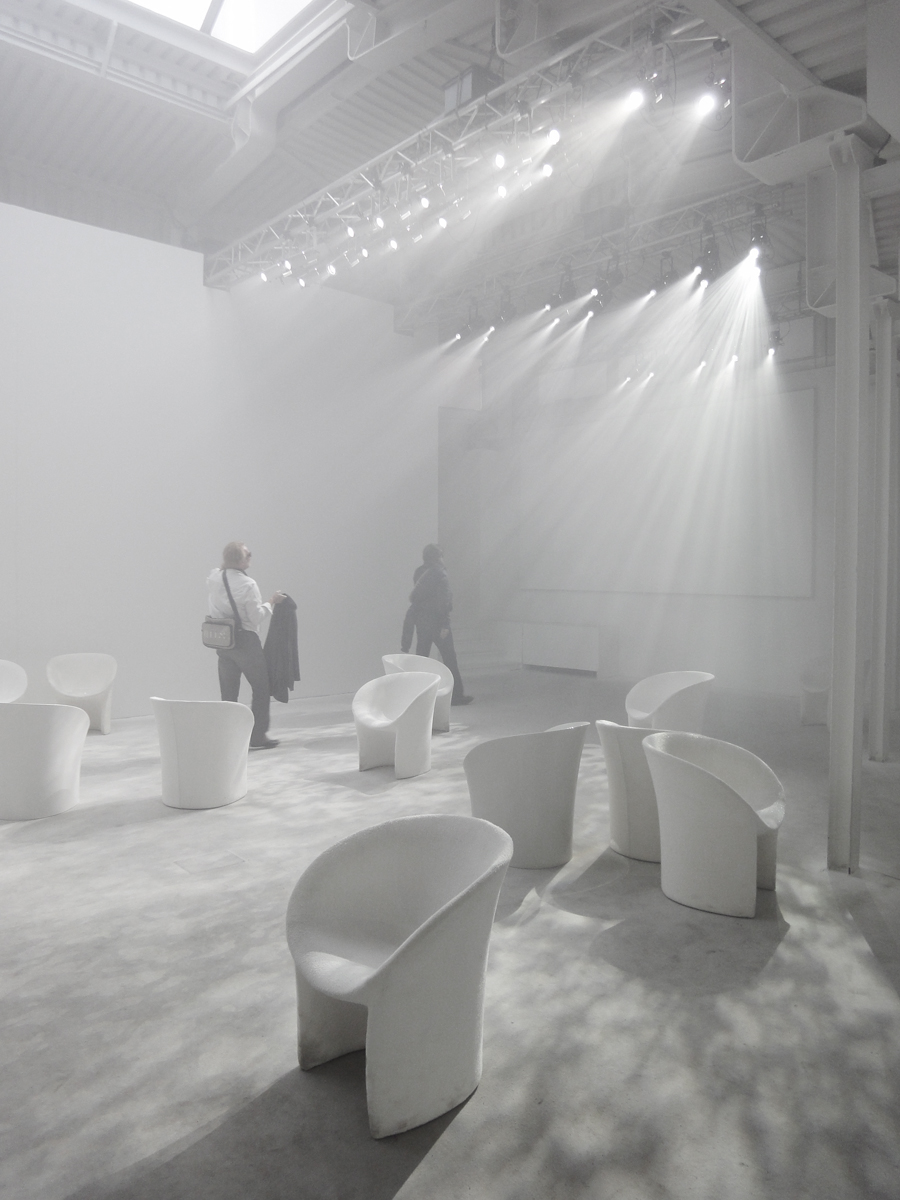
Elsewhere in the city, showrooms also stage special events. Moroso in Brera presents Tokujin Yoshioka's Moon chair with his own design of the setting. Called Twilight, the installation comprised artificial mist in the air with beams of light penetrating through. Nature is powerful and mysterious. We should know it more vividly now.


The most fascinating display should be InterfaceFLOR's "The Positive Floor" at the Triennale Museum, developed by Milan-based designer Francesco Maria Bandini. The room is filled with white prism columns, forming a labyrinth that seems like a huge mass cracked apart. These prisms are taller than a person, so the carpets with vibrant colors on top can only be seen as reflections on the mirrored ceiling. As visitors move through the maze, they have to look up. And the colorful carpets almost act like a compass, giving orientations from the top of the head. A physical journey is turned into the surreal - another reality on another level, which finally reveals itself when visitors ascend the stairs embedded in one of the last prisms.