Sunday, August 7, 2011

YAP @ MAXXI

     
I can't see YAP at PS1 this year (probably didn't miss much...), but I made it to Rome for the first ever YAP MAXXI.

MoMA PS1 joined force with MAXXI to launch the Italian edition of the established Young Architects Program. For over ten years in New York, YAP have brought in emerging young talents such as SHoP, WORKac, MOS, and SO-IL to transform the courtyards of PS1 into temporary summer events spaces with shade and water. This year for the MAXXI plaza, young Roman office stARTT was chosen as winner of the first YAP in Europe. The scheme WHATAMI injects a series of artificial green islands across the outdoor space. The main island, closer to the northeast corner of the site, features several zones of different qualities for people to hang out and relax. A "river" runs in front and forms a nice recreational "water edge." Large red calla lilies grow out of the grass and provide shading in the day and lighting at night. I feel that this is more about offering a nice and attractive place to the visitors than an "architectural" geometry play in the other YAP at PS1.


It's interesting to see the notion of architecture and gender here. Zaha's concrete building is curvy, but extremely severe and imposing at the same time. Right next to it, the male team of stARTT introduces more natural elements and to some extent they soften the aggressiveness of the strong lady with cheerful summer minds. The museum building and the new intervention co-exist in harmony, and they seem to be even complementary in a funny way.

I was surprised how well this was built. I know the PS1 budget was always so tight ($60,000-85,000, varying from year to year) that the architects usually chose very cheap materials and relied on volunteers for construction. I guess the recycled or natural materials that stARTT used, such as polystyrene and pressed hay, could still be considered "cheap." But in the making-of video shown in the gallery, I saw professional construction workers and serious metal cutting and welding work. Also, the red "flowers" were so well made that they easily top all the PS1 constructions I've seen. Maybe the city was convinced to increase funding because these high-tech objects were supposed to be relocated throughout Rome, in one of those abandoned places waiting for rehabilitation.
     

Wednesday, August 3, 2011

Art on the margin

   
Parallel to the main Art Basel, there were several smaller shows happening in the city. Design Miami/ Basel, showcasing 20th and 21st century design, was one of the prestigious ones. It was not as massive as the Milan fair, but it still had quite a few interesting things.
Design Miami/ Basel at Messe Hall 5, with Nacho Carbonell's outdoor pieces Playground Closes at Dusk
The Aranda\Lasch designed "scattered" floor layout

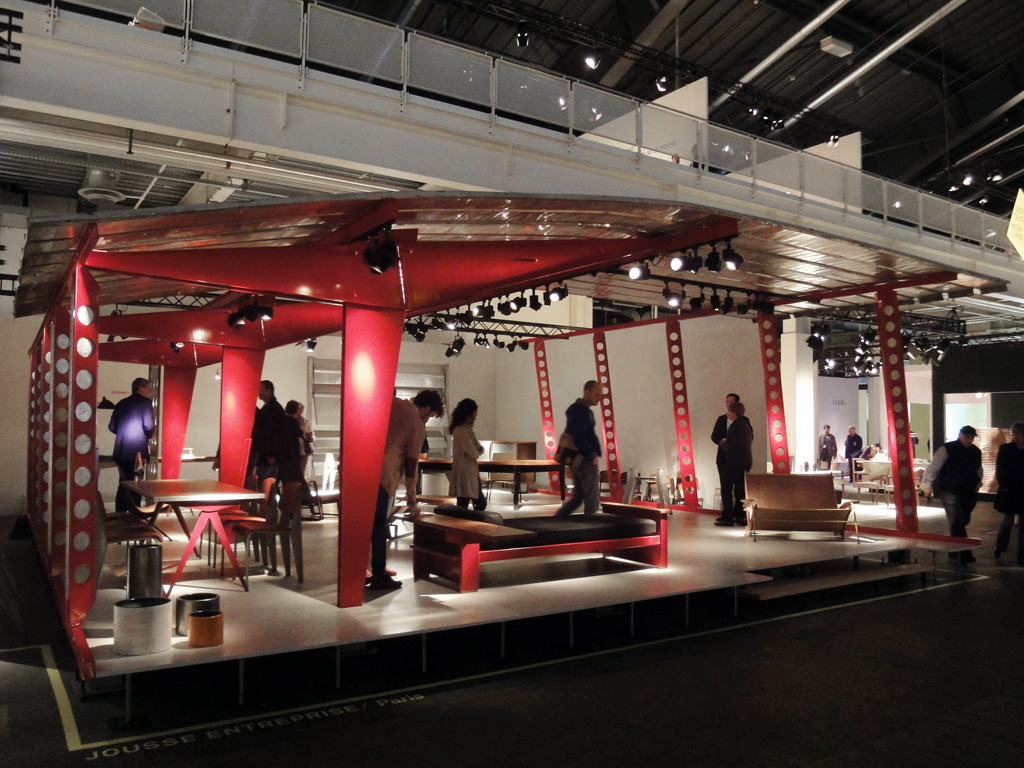
Jean Prouvé seemed to be the superstar this year. Both Jousse Entreprise and Galerie Patrick Seguin dedicated their booths to his work, not mentioning the chairs and tables scattered around in the hall.
Jean Prouvé at Jousse Entreprise booth
Galerie Patrick Seguin constantly assembles and dissembles Jean Prouvé's 6x6m demountable house

I spotted this chandelier I saw before as a wall installation at the "Dead or Alive" exhibition in New York. Ralph Nauta & Lonneke Gordijn of DRIFT gathered dandelions, removed the puffs and then painstakingly glued them back seed by seed to a constellation of LED lights.
DRIFT, Fragile Future 3 Chandelier, 2010

As one of the winners of the "Designers of the Future Award," London-based architect-designer Asif Khan devised an archetypal space with helium gas, water and soap. Soap bubbles slowly rose into the air, floating upward and eventually caught by a fish net stretched across the ceiling.
Asif Khan, Cloud, 2011

The most impressive work at Design Miami/ Basel was the Luciferase series by Spanish artist Nacho Carbonell. Considered as "light-producing creatures," the pieces took inspiration from flora and fauna living in abysses, with their extraordinary colors, textures, and gesture. The effects were beautiful, resembling the seductive sparkling quality of amethyst, quartz, and malachite.
Nacho Carbonell, Luciferase series, 2011

Other concurrent shows, including Scope and Liste, provided venues for emerging galleries and artists who were "too young to get into the main fair." Perhaps these shows were simply smaller so that the art could get more attention. I felt I saw a higher concentration of talents here, with fresh insights and more innovative techniques.
Scope 11 at Kaserne
Liste 16 at Werkram Warteck pp

Patrick Cornillet's oil paintings of isolated building elements, Andrew Rogers' land art, Alex and John Gailla's red nylon wire sculptures, and Samsul Arifin's installation with ricesack figures were among the nice things at Scope.
Patrick Cornillet, Structure
Andrew Rogers, Rhythms of Life: Shield, Kenya, 2010
Alexandre and John Gailla, Crucifixion (left); La Lutte (front)
Samsul Arifin, Goni's Voice, 2011

American artists Alex Schweder and Ward Shelley participated in Scope with their interesting performance piece. For the five days of the show, the two artists lived in a self-contained vertical living unit. Tied to either end of a single rope, the two had to depend on each other to move up and down their habitat, even to the kitchen and bathroom. With Schweder's architectural background (Pratt-Princeton), this artwork explored several architecture-related issues better than many "experimental" houses. It reexamined notions such as everyday domestic routine, modes of circulation, building-inhabitant interactions, and ultimately, interpersonal relationships.
Alex Schweder and Ward Shelley, Counterweight Roommate, 2011
Counterweight Roommate concept model

Digital technology is one of the trending issues in art today, especially among young artists. The "Principia" exhibition during the Milan Design Week put together some 3D-printed sculptures and a robot arm drawing portraits. This time at Scope in Basel, there was a machine painting in color pixels, very similar to the way drawings were made in the TV drama series Kyle XY.

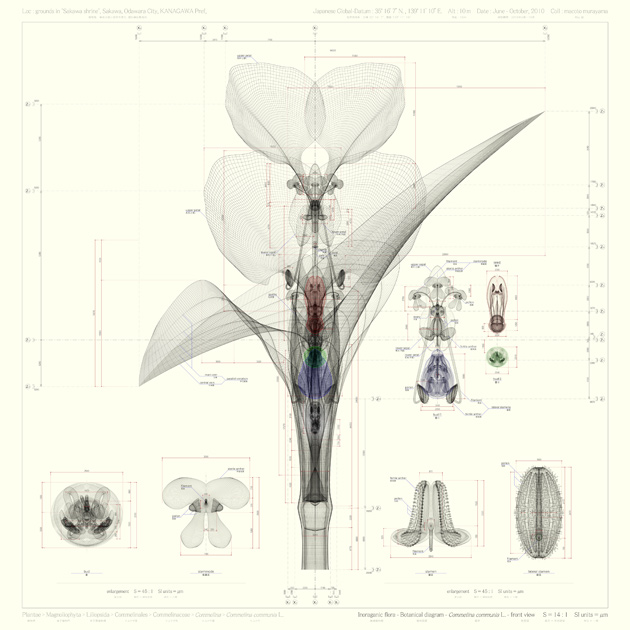
Young Japanese artist Macoto Murayama used 3D modeling and graphic softwares to create inorganic flora in uncanny details, bringing the power of science and the fantasy of art together.
Macoto Murayama, Commelina communis L. - front - ow, 2011
Macoto Murayama, Commelina communis L. - side view - b2011

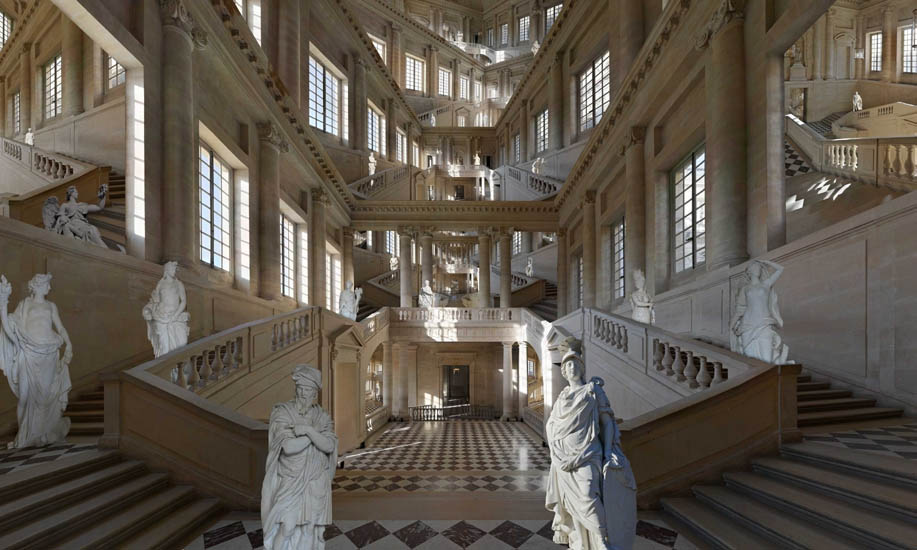
On the slightly less high-tech side, artists used computer graphic techniques to create surreal collages. They appropriated either masterpieces or familiar built environments and turned them into bizarre scenarios.
Lluis Barba, Santa Cena, Leonardo, 2009
Tom Leighton, Appropriation of Space: Venice 1, 2010
Jean-Francois Rauzier, Vestibule

Appropriation could lead to another characteristic of young art - humor. In Liste, I couldn't help laughing when I saw Romanian artist Ciprian Mureşan showing the probable result of Yves Klein's Leap into the Void, and a mock Calvin Klein advertisement by the Chinese group Double Fly.
Ciprian Mureşan, Leap into the Void, after 3 seconds, 2004
Double Fly Group, Brand Franchise, 2010

Swiss artist MARCK's work showed a good synthesis of technology and humor. His video art typically featured a woman (his life partner Sandra) in a metal box, seemingly trying to avoid a swaying sickle or finding her way between the screws. This direct confrontation with the Urangst would make us think about relations between the physical and the virtual, reality and imaginations.
MARCK, Dornen, 2009
 

Friday, July 29, 2011

Where history meets contemporary art

  
After the successful introduction to Art Basel last year by Jens Hoffman, the Art Parcours program returned this year for its second edition in the St. Alban Tal area along the Rhine. The idea was to create a strong interaction with Basel's past and present, weaving artistic interventions into the fabric of the historic city. "The fair halls are so clean and proper and without much character that the historical buildings that we have chosen seem like the best contrast," Hoffman explained. In my opinion, it was exactly this contrast that made Art Parcours a million times more interesting.

Some of the venues were old houses in the neighborhood. Gabriel Sierra inserted various wooden structures in the different rooms of Raum33, marking the spatial sequence between the street and the riverfront. Anne Chu covered the floor of Hohen Dolder House with large rugs inspired by the deer-antler motifs in the surrounding murals.

Gabriel Sierra, Untitled, Estructures for transition #9
Anne Chu, A resting place with William Tell

Janet Cardiff and George Bures Miller showed their playfulness in the pop-up bar inside an old water reservoir. Through a heavy old door and a dimly-lit staircase, you entered a vaulted space with a tiki hut in the middle. There were dancing waves projected on the damp walls, tropical music playing in the background, and a couple of bartenders serving you colorful fruity cocktails.
Janet Cardiff and George Bures Miller, Blue Hawaii Bar

On a cargo ship, Chris Johanson built a stage for his own Art Parcours Night performance with his band Sun Foot. I don't know how it looked during the party. But in the day, it didn't find it so appealing.
Chris Johanson / Sun Foot, An Evening of Going Through Things and Looking at Each Other with Each Other

Along the river bank, Costa Rican artist Federico Herrero painted four fishing huts with colors and shapes from his hometown San José, bringing an unusual festive atmosphere to the quite Swiss town.
Federico Herrero, Vibrantes

It was ironic to see Ai Weiwei's work on the old city wall. In a way, these remains of the medieval fortification reminded me of the various walls in China and the artist in prison.
Ai Weiwei, Fairytale People

In front of the Museum of Contemporary Art, Yinka Shonibare "decorated" the trees along the river with hundreds of kites of different colors and patterns. They could be flying or trapped, depending on your mood when you saw it I guess.
Yinka Shonibare, 500 Kites

Three sculptures by Ugo Rondinone from the Scholar Rocks series were placed in the St. Alban churchyard. Well, you know what it is - I don't have too much to say about this.
Ugo Rondinone, Scholar Rocks

The best work of all was inside the St. Alban Church, where Belgian artist Kris Martin covered the floor with innumerable tiny bronze discs. It was extremely moving because of the multiple layers of dual qualities: subtlety and strong presence; playfulness and sublime; specificity and ambiguity; form and formless; transience and eternity. It gave us a great example of well-balanced intervention and interaction.
Kris Martin, Festum II